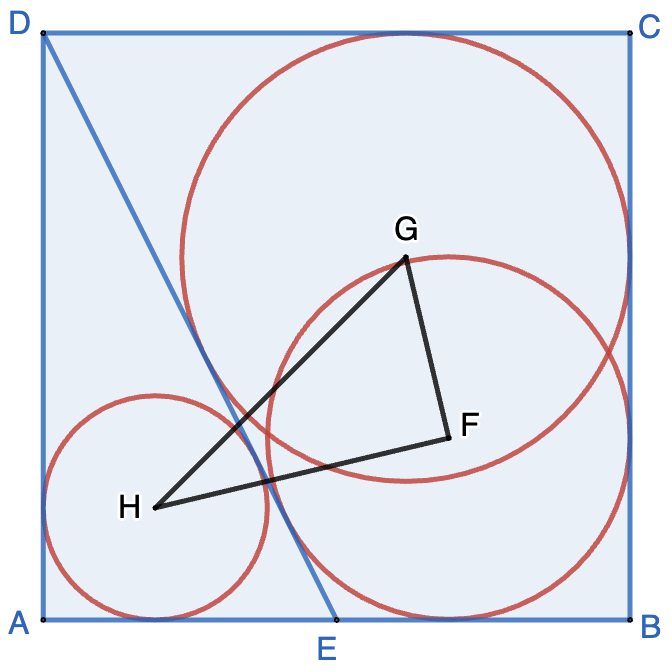
As shown in the figure, $ABCD$ is a square, $E$ is the mid-point of $AB$. The circle with its center at $H$ is tangent with $AD$, $AE$ and $DE$. The circle with its center at $F$ is tangent with $BC$, $BE$ and $DE$. The circle with its center at $G$ is tangent with $BC$, $CD$ and $DE$. Prove that $\triangle{FGH}$ is a right triangle. Click here for the proof.
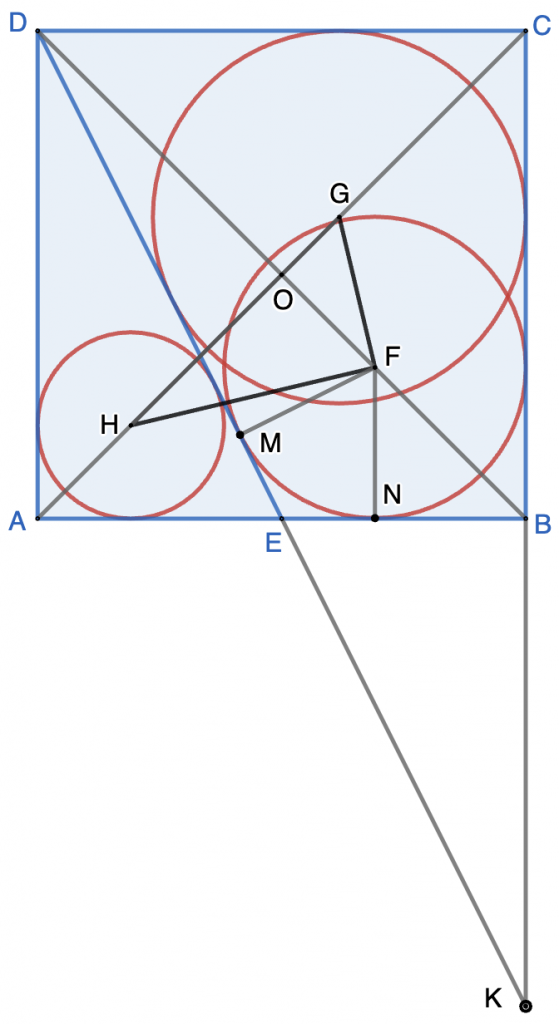
Proof: Extend $DE$ and $CB$ so that they intersect at $K$. Draw diagonals of $ABCD$ so that they intersect at $O$. Let $M$ and $N$ are tangent points of circle $F$ on $DE$ and $AB$ respectively, we have $FM\perp DE$ and $FN\perp AB$. Additionally, without loss of generality, we assume that $ABCD$ is a unit square. It is obvious that $F$ is on $BD$, $G$ and $H$ are on $AC$.
Let the radius of circle $F$, $G$, $H$ as $f$, $g$, $h$ respectively. We have ${DF}^2={FM}^2+{DM}^2$
We have $$((1-f)\sqrt{2})^2=(\dfrac{\sqrt{5}-1}{2}+f)^2+f^2$$
Solve the above equation, we have $$f=\dfrac{\sqrt{5}-1}{4}$$
Since the perimeter of $\triangle{DAE}$ is $\dfrac{3+\sqrt{5}}{2}$, and its area is $\dfrac{1}{4}$. Therefore, $$h=\dfrac{2\cdot\dfrac{1}{4}}{\dfrac{3+\sqrt{5}}{2}}=\dfrac{3-\sqrt{5}}{4}$$
Since $\triangle{DAE}\sim \triangle{KCD}$, and $CD=2{AE}$, therefore $$g=2h=\dfrac{3-\sqrt{5}}{2}$$
It is easy to show that ${FO}^2={GO}\cdot{HO}$, therefore, $\triangle{FGH}$ is a right triangle.
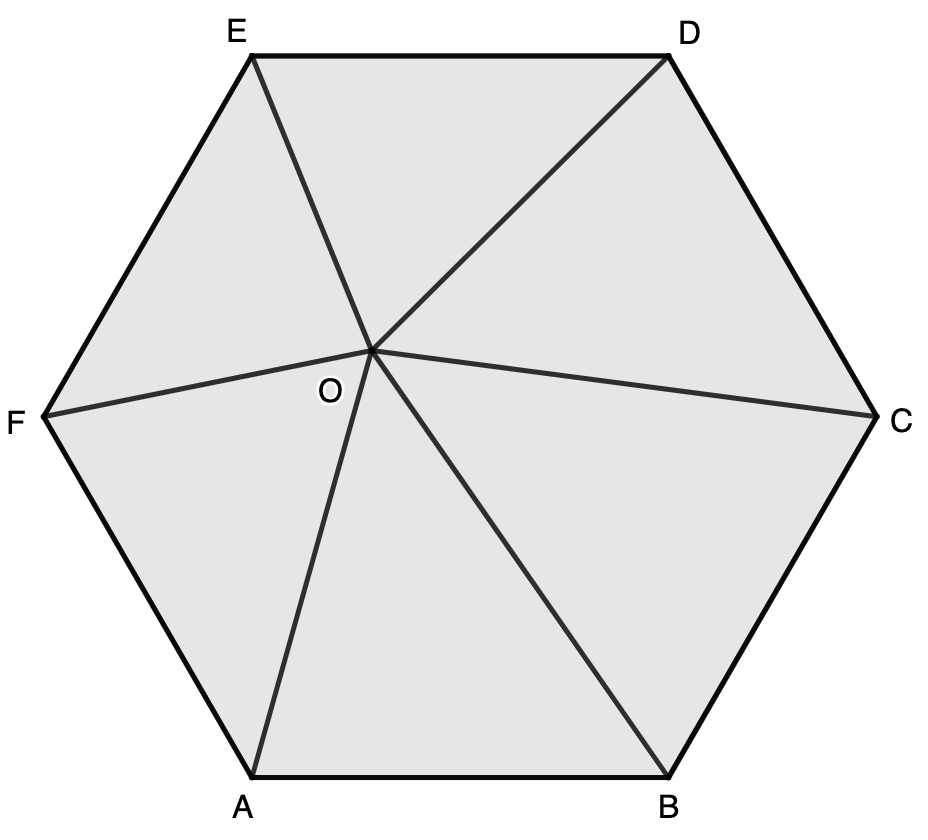
Proof 1: Without loss of generality, assume that $ABCDEF$ is unit regular hexgon with its center at $(0,0)$, $A$ at $(-\dfrac{1}{2},-\dfrac{\sqrt{3}}{2})$, $B$ at $(\dfrac{1}{2},-\dfrac{\sqrt{3}}{2})$, $C$ at $(1,0)$, etc. Then the liner equations for line $AB$, $BC$, $CD$, and $EF$ are:
$y+\dfrac{\sqrt{3}}{2}=0$
$\sqrt{3}x-y-\sqrt{3}=0$
$\sqrt{3}x+y-\sqrt{3}=0$
$\sqrt{3}x-y+\sqrt{3}=0$
Let $O$ at $(a, b)$. Denote $O(XY)$ as the distance from $O$ to line $XY$. The distances from $O$ to $AB$, $BC$, $CD$ and $EF$ are:
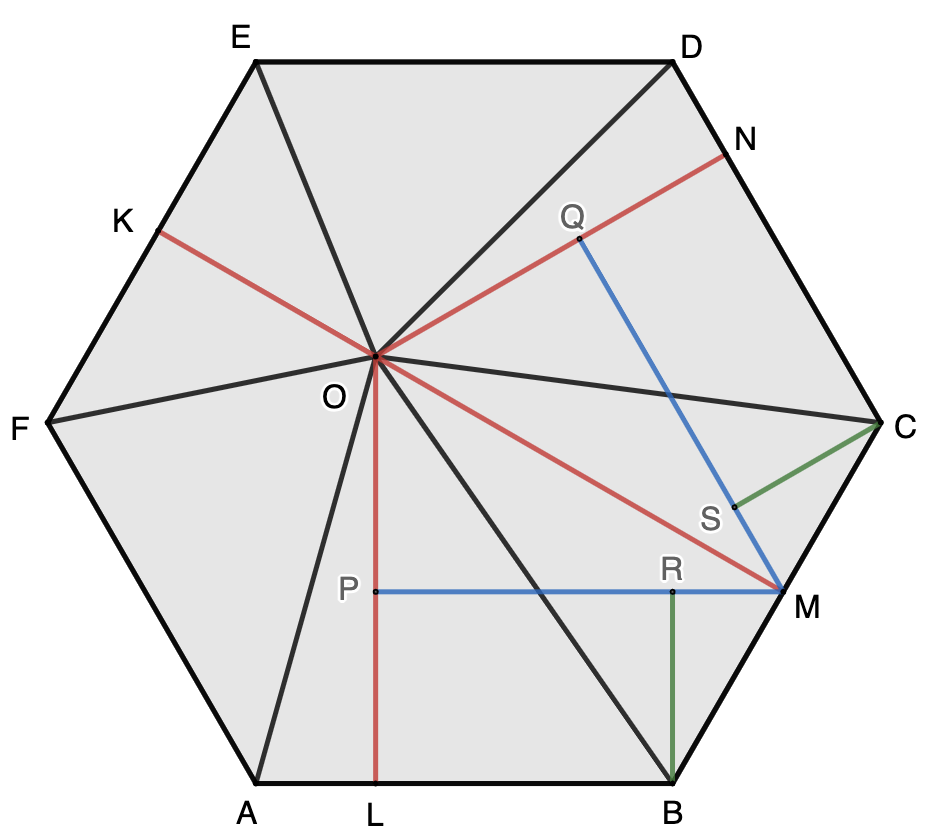
Because $MB+MC=BC=1$, we have $$\dfrac{2\sqrt{3}}{3}(OL-\dfrac{1}{2}OM)+\dfrac{2\sqrt{3}}{3}(ON-\dfrac{1}{2}OM)=1\tag{1}$$
Simplifying $(1)$, we have $$OL+ON-OM=\dfrac{\sqrt{3}}{2} \tag{2}$$
Because $BC\parallel EF$, $OK\perp EF$ and $OM\perp BC$, $M$, $O$ and $M$ are co-linear and $$OK+OM=KM=\sqrt{3}$$
Applying $(2)$, We have $$OK=\sqrt{3}-OM=2(OL+ON-OM)-OM=2\cdot OL+2\cdot ON-3\cdot OM$$
which implies $[\triangle{OEF}]=2[\triangle{OAB}]+2[\triangle{OCD}]-3[\triangle{OBC}]$.
Proof 3: Without loss of generality, assume that $ABCDEF$ is unit regular hexgon.
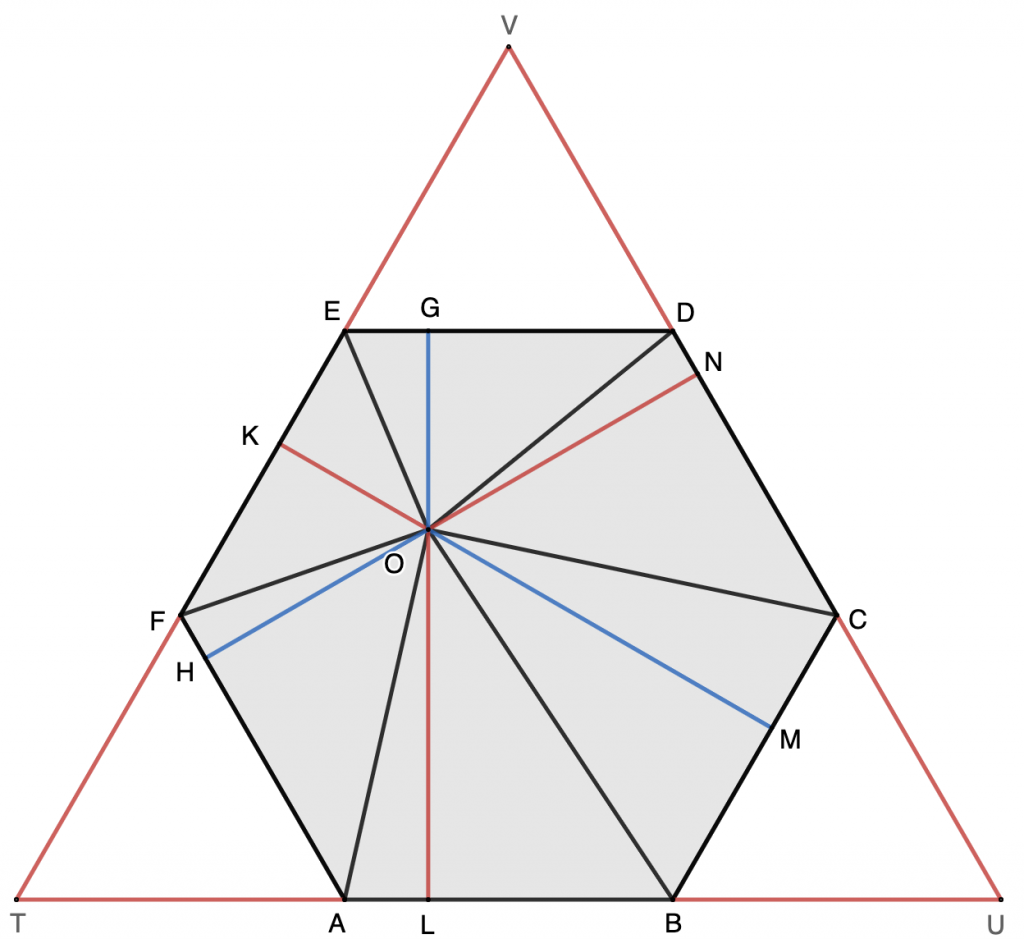
Let $GL$ pass $O$ and $GL\perp AB$, $KM$ pass $O$ and $KM\perp BC$, $HN$ pass $O$ and $HN\perp CD$. As $ABCDEF$ is a regular hexgon, $AB\parallel DE$, $BC\parallel EF$, and $CD\parallel FA$. Therefore $GL\perp DE$, $KM\perp EF$, and $HN\perp FA$.
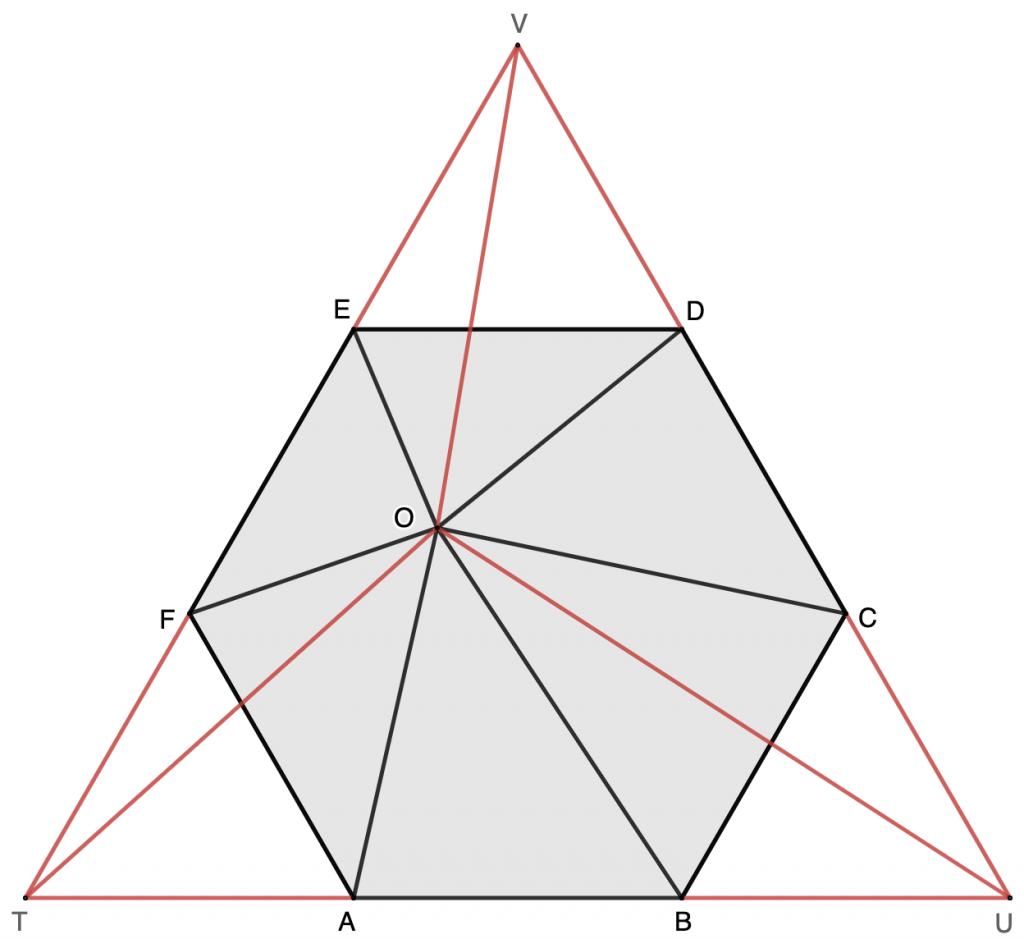
Extend $AB$, $CD$, and $EF$ to form equilateral $\triangle{TUV}$, with its side length as $3$. Because $OK\perp VT$, $OL\perp TU$, and $ON\perp UV$, we have $$OK+OL+ON=\dfrac{3\sqrt{3}}{2}\tag{1}$$
as $OK$, $OL$ and $ON$ are heights of $\triangle{OEF}$, $\triangle{OAB}$ and $\triangle{OCD}$ respectively and their sum is equal to the height of equilateral $\triangle{TUV}$. Similarly, $$OG+OH+OM=\dfrac{3\sqrt{3}}{2}\tag{2}$$
In right triangle ABC, with AB = 44 cm and BC = 33 cm, point D lies on side BC so that BD:DC = 2:1. If vertex A is folded onto point D to create quadrilateral BCEF, as shown, what is the area of triangle CDE? Click here for the solution.
Solution 1: Obviously, $\triangle{ABC}$ is a 3-4-5 triangle with $AC=55$.
Because $BD:DC=2:1$, and $BC=33$, we have $BD=22$, $CD=11$.
Let $BF=x$, $AF=DF=AB-BF=44-x$. Because $\triangle{BDF}$ is a right triangle, according to Pythagorean Theorem, we have
Solve the above equation, we have $x=\dfrac{33}{2}$. Therefore $BF=\dfrac{33}{2}$, $AF=\dfrac{55}{2}$.
Draw line $AD$ intersecting $EF$ at $G$, and extend $EF$ and $CB$ intersecting at $H$, as shown below. We have $AG\perp EF$ as $\triangle{DEF}$ is a reflection of $\triangle{AEF}$ along line $EF$. $\triangle{AGF}$ is a right triangle.
Therefore, $\triangle{AGF}\sim\triangle{ABD}\sim\triangle{HBF}$. We have $$\dfrac{HB}{BF}=\dfrac{AB}{BD}=\dfrac{44}{22}=2$$ Therefore $HB=2BF=33$, and $CH=HB + BC=66$.
According to Menelaus’s Theorem, we have $$\dfrac{CH}{HB}\cdot\dfrac{BF}{FA}\cdot\dfrac{AE}{EC}=1$$i.e.
Because $$AE+EC=AC=55\tag{3}$$ Solving (2) and (3), we have: $AE=25$, $EC=30$.
Because $\triangle{DEF}$ is a reflection of $\triangle{AEF}$, $DE=AE=25$. So the lengths of three sides of $\triangle{CDE}$ are $a=11$, $b=25$, and $c=30$. According to Heron’s formula, we have $$s=\dfrac{a+b+c}{2}=33$$ and the area of $\triangle{CDE}$ is
Because $\triangle{DEF}$ is a reflection of $\triangle{AEF}$, $AG\perp GE$. Therefore, $\triangle{AGE}\sim\triangle{AHD}$ and $AG=\dfrac{1}{2}AD=11\sqrt{5}$.
The area of $\triangle{ACD}$ is $$[\triangle{ACD}]=\dfrac{1}{2}AB\cdot CD=\dfrac{1}{2}\times 44\times 11=242$$
Because $[\triangle{AHD}]=\dfrac{1}{2}AC\cdot DH$, we have $$242=\dfrac{1}{2}\times 55\cdot DH$$
Therefore $DH=\dfrac{44}{5}$.
Because $\triangle{AHD}$ is a right triangle, we have $$AH=\sqrt{AD^2-DH^2}=\sqrt{(22\sqrt{5})^2-(\dfrac{44}{5})^2}=22\sqrt{5-\dfrac{4}{25}}=22\times\dfrac{11}{5}=\dfrac{242}{5}$$
Because $\triangle{AGE}\sim\triangle{AHD}$, we have $$\dfrac{GE}{AG}=\dfrac{DH}{AH}=\dfrac{\dfrac{44}{5}}{\dfrac{242}{5}}=\dfrac{2}{11}$$
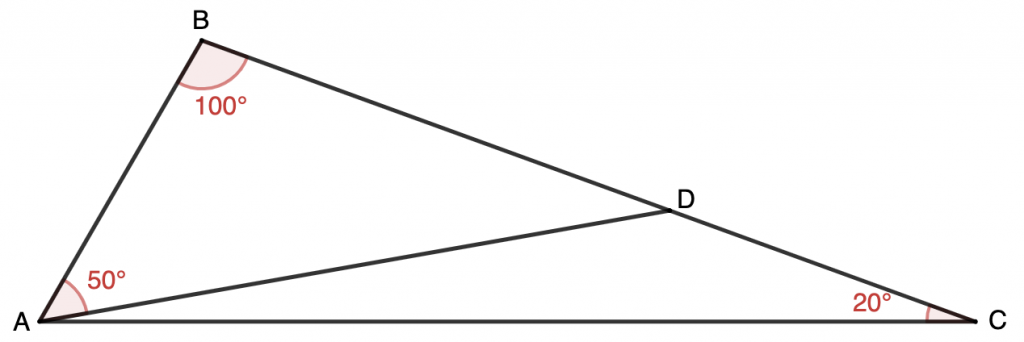
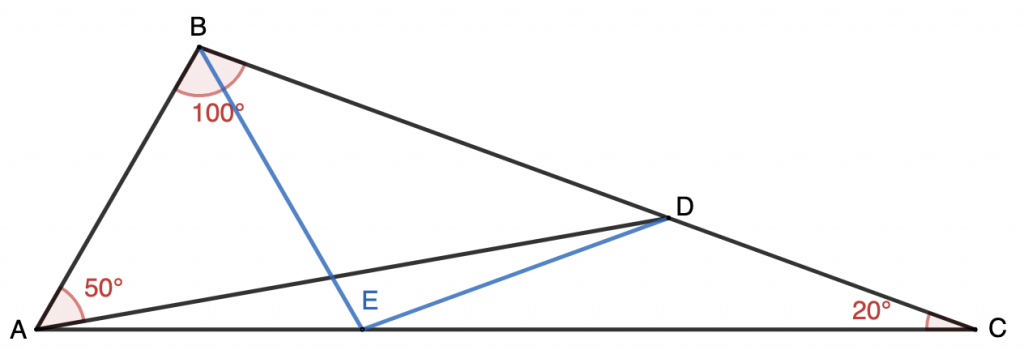
As $\angle{BAE}=60^\circ$, $\triangle{ABE}$ is equilateral. Therefore $\angle{AEB}=60^\circ$
Because $\angle{ADB}=30^\circ$, $\angle{AEB}=2\angle{ADB}$, and $EA=EB$, $D$ must be on the circle with its center at $E$ and its radius as $EB$. Therefore $AE=BE=DE$. And $\triangle{AED}$ is isosceles.
We have $\angle{CED}=\angle{DAE}+\angle{ADE}=10^\circ+10^\circ=20^\circ$. Therefore $\triangle{CDE}$ is isosceles. $CD=DE$. As $DE=BE=AE=AB$, we have $AB=CD$.