Lisa wants to use her calculator to square a two-digit positive integer, but she accidentally enters the tens digit incorrectly. When she squares the number entered, the result is 2340 greater than the result she would have gotten had she correctly entered the tens digit. What is the sum of the two-digit number Lisa entered and the two-digit number she meant to enter? Source: 2019 MATHCOUNTS Chapter Sprint Round. Click here for the solution.
Solution
Lets assume the bigger 2-digit number is \(10x+y\), and the smaller 2-digit number is \(10z+y\), we have:
$$(10x + y)^2-(10z+y)^2=2340$$
$$100x^2+20xy+y^2-(100z^2+20zy+y^2)=2340$$
Simplify the above equation, we have:
$$(x-z)(5x+y+5z)=117=1\cdot 3\cdot 3\cdot 13$$ $$ \because 10 > x > z > 0 $$ $$\therefore x-z=1 \ \ or \ \ x-z=3 $$
If \(x-z=1\), we have
$$ 5x + y + 5z=117 $$
which is impossible, as the maximum possible value of \(5x+y+5z\) is 99. Therefore,
$$x-z=3\tag{1}$$ $$5x+y+5z=39\tag{2}$$
From (1), we have
$$x=z+3\tag{3}$$
Based on (2) and (3), we have
$$5(z+3)+y+5z=39$$
Simplify the above equation, we have
$$y+10z=24$$
Since \(y\) and \(z\) are single digit numbers, the only solution is
$$ y=4 \ \ \ and \ \ \ z=2$$
Therefore \(x=5\). The sum of \(10x+y\) and \(10z+y\) is
$$ 54+24=78$$
Posted inAlgebra, MATHCOUNTS|Comments Off on MATHCOUNTS Exercises – 14
In regular pentagon $ABCDE$, point $M$ is the midpoint of side $AE$, and segments $AC$ and $BM$ intersect at point $Z$. If $ZA = 3$, what is the value of $AB$? Express your answer in simplest radical form. Source: MATHCOUNTS 2015 State Sprint Round.Click here for the solutions.
Solution 1 Draw line $\overline{BE}$ intersecting with line $\overline{AC}$ at $F$. Obviously, quadrilateral $CDEF$ is a rhombus, and both $\triangle{BAF}$ and $\triangle{BEA}$ are similar isosceles triangles.
Let $\overline{AB}=\overline{AE}=\overline{EF}=x$, $\overline{AF}=\overline{BF}=y$, $$\because \triangle{BAF}\sim\triangle{BEA}$$ $$\therefore \dfrac{\overline{BA}}{\overline{BF}}=\dfrac{\overline{BE}}{\overline{BA}}\tag{1}$$ $$\dfrac{x}{y}=\dfrac{x+y}{x}=\dfrac{1}{1+\dfrac{x}{y}}$$ Solve the above equation for $\dfrac{x}{y}$ and ignore the negative value, we have $$\dfrac{x}{y}=\dfrac{\sqrt{5}+1}{2}\tag{2}$$
Let $G$ be the midpoint of $\overline{AF}$. Since $M$ is also the midpoint of $\overline{AE}$, we have $\overline{MF} \parallel \overline{BE}$, therefore $$\triangle{AMZ}\sim\triangle{AEF}$$ Because $\overline{AE}=\overline{EF}=x$, therefore $$ \overline{MA}=\overline{MG}=\dfrac{\overline{AE}}{2}=\dfrac{x}{2}$$ Additionally $$\because \triangle{MGZ}\sim\triangle{BFZ}$$ $$\therefore \dfrac{\overline{ZG}}{\overline{ZF}}=\dfrac{\overline{MA}}{\overline{BF}}=\dfrac{\dfrac{x}{2}}{y}=\dfrac{1}{2}\cdot\dfrac{x}{y}$$
Therefore $$\overline{ZG}+\overline{ZF}=\dfrac{1}{2}\cdot\dfrac{x}{y}\cdot\overline{ZF}+\overline{ZF}=(\dfrac{1}{2}\cdot\dfrac{x}{y}+1)\cdot\overline{ZF}$$
$$\because \overline{ZG}+\overline{ZF}=\overline{GF}=\dfrac{y}{2}$$
$$\therefore (\dfrac{1}{2}\cdot\dfrac{x}{y}+1)\cdot\overline{ZF}=\dfrac{y}{2}$$
$$\because \overline{ZF}=\overline{AF}-\overline{AZ}=y-3$$
$$\therefore (\dfrac{1}{2}\cdot\dfrac{x}{y}+1)\cdot(y-3)=\dfrac{y}{2}\tag{5}$$
Solve equation (2) and (5), we have $$y=\dfrac{15-3\sqrt{5}}{2}$$
And finally we have the answer: $$\overline{AB}=x=\dfrac{x}{y}\cdot{y}=\dfrac{\sqrt{5}+1}{2}\cdot\dfrac{15-3\sqrt{5}}{2}=3\sqrt{5}$$
Solution 2 – Use Mass Points Method Follow the same process as Solution 1 to obtain the result shown in (2).
Assign $A_{mass}=1$, because $M$ is the midpoint of side $\overline{AE}$, we have $$E_{mass}=1, \ \ \ M_{m a s s}=A_{mass}+E_{mass}=2$$ $$\because \dfrac{\overline{EF}}{\overline{BF}}=\dfrac{x}{y}$$ $$\therefore B_{mass}=\dfrac{x}{y}$$ We have $$F_{mass}=E_{mass}+B_{mass}=1+\dfrac{x}{y}\tag{6}$$ and balanced mass at $Z$ as $$Z_{mass}=M_{mass}+B_{mass}=A_{mass}+F_{mass}=2+\dfrac{x}{y}$$ Therefore $$A_{mass}\cdot\overline{AZ}=F_{mass}\cdot\overline{FZ}=F_{mass}\cdot(\overline{AF}-\overline{AZ})$$ i.e. $$1\cdot 3=(1+\dfrac{x}{y})(y-3)\tag{7}$$
Solve equation (2) and (7), we have $$y=\dfrac{15-3\sqrt{5}}{2}$$
And finally we have the answer: $$\overline{AB}=x=\dfrac{x}{y}\cdot{y}=\dfrac{\sqrt{5}+1}{2}\cdot\dfrac{15-3\sqrt{5}}{2}=3\sqrt{5}$$
Solution 3 – Use Menelaus‘ theorem Follow the same process as Solution 1 to obtain the result shown in (2).
According to Menelaus’ theorem, we have the following:
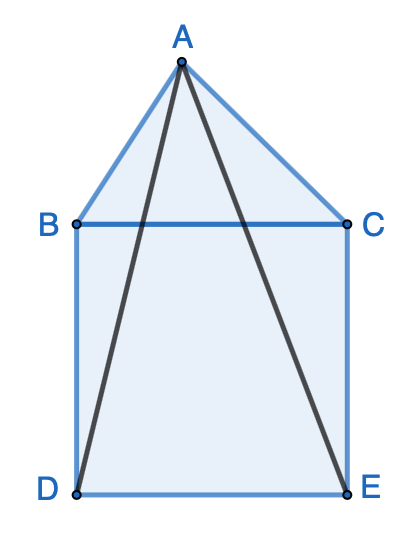
In $\triangle{ABC}$, $\overline{AB}=5$, $\overline{AC}=6$, $\overline{BC}=7$. Square $BCED$ is drawn along the side of $\overline{BC}$, as shown in the following figure. Find the area of $\triangle{ADE}$. Click here for the hint.
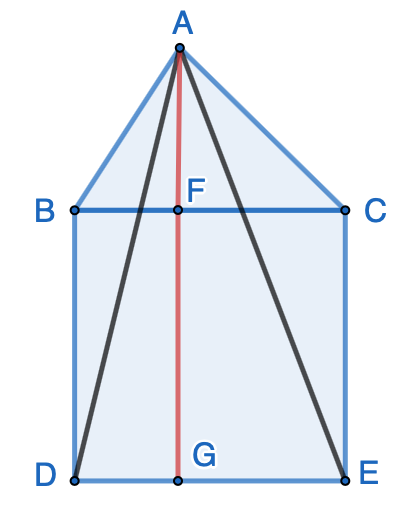
Hint Draw the altitude from $A$ of $\triangle{ABC}$ intersecting $\overline{BC}$ at $F$ and $\overline{DE}$ at $G$. Try to find the length of $\overline{AF}$ and $\overline{AG}$.
8 semi-circles are drawn along the side lines inside of a unit square as shown in the following figure, with another circle centered at the center of the square and tangent to all of 8 semi-circles. What is the area of the square not covered by the circle and semi-circles (i.e. the green area)? Click here for the solution.
Lets draw line $\overline{GI}$, between the midpoint of a side of the square, and the center of the circle; $\overline{IJ}$, between the center of circle and that of a semi-circle on the same side of point $G$, thru the tangent point of the circle and the semi-circle; line $\overline{JK}$, between the center of the semi-circle and the intersect point $K$ with its adjacent semi-circle; and line $\overline{DK}$, between the corner of the square adjacent to point $G$ and $K$.
Obviously, the radius of the semi-circles is $$s=\dfrac{1}{4}$$ The area marked in blue color is $$A_{blue}=\dfrac{1}{4}\pi s^2+\dfrac{1}{2}s^2=\dfrac{2+\pi}{64}$$ Therefore, the total area of overlapping semi-circles is $$A_s=8\cdot A_{blue}=8\cdot\dfrac{2+\pi}{64}=\dfrac{2+\pi}{8}$$
Assume the radius of the circle centered at $I$ is $r$. Because $\triangle{GIJ}$ is a right triangle, we have: $$s^2+(\dfrac{1}{2})^2=(r+s)^2$$ i.e $$(\dfrac{1}{4})^2+(\dfrac{1}{2})^2=(\dfrac{1}{4}+s)^2$$
Solve the above equation and ignoring the negative $r$ value, we have: $$r=\dfrac{\sqrt{5}-1}{4}$$ Therefore, the area of the circle is $$A_{r}=\pi r^2=\pi(\dfrac{\sqrt{5}-1}{4})^2=\dfrac{3-\sqrt{5}}{8}\pi$$ And the area of not covered by the circles is $$A_{green}=1-A_{s}-A_{r}=1-\dfrac{2+\pi}{8}-\dfrac{3-\sqrt{5}}{8}\pi=\dfrac{3}{4}-\dfrac{1}{2}\pi+\dfrac{\sqrt{5}}{8}\pi \approx 0.0573$$
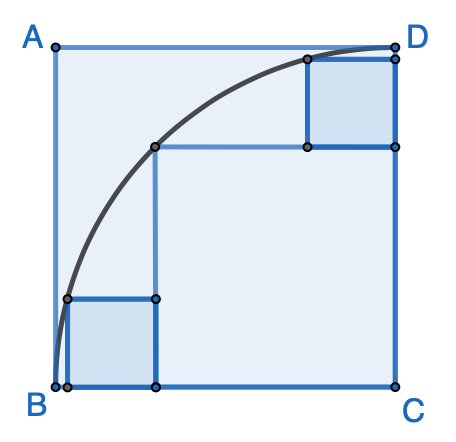
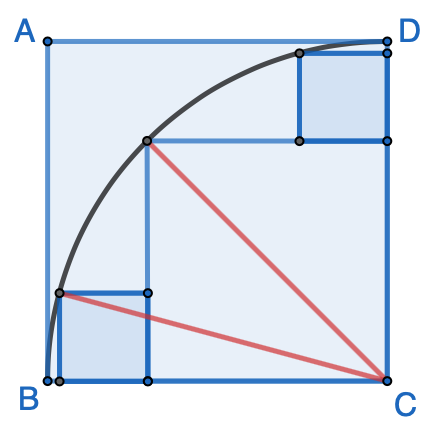
As shown in the following figure, a quarter circle is drawn in a unit square, and 3 smaller squares are inscribed inside the quarter circle. Find the total area of the 3 smaller squares. Click here for the hint.